
This article is the third of a four-part series by CCJC explaining the doctrine of separation of powers and how governmental power in Singapore is trifurcated into the three branches of Government. This article introduces the Legislature and will answer three questions: How does the electorate know which constituency to vote in? Who then serves within Parliament? Finally, how are laws made? Before moving forward, it is important to highlight that the Legislature is made up of both the President and the Parliament. However, since the powers of the President have been explored in our article explaining the Executive branch of government, this article will focus on Parliament instead.
How does the electorate know where to vote?
One commonly asked question during the General Elections was: “How do we know which areas of Singapore belong to which constituency?” The confusion largely stems from the fact that a constituency could cover multiple areas, for example the Jurong East-Bukit Batok GRC. At this juncture, it is vital to clarify that constituencies are not bound by the area of MRT stations (therefore, one MRT station does not equal to one constituency).
Instead, the area for each constituency is decided by the Electoral Boundaries Review Committee (“EBRC”) who redraw the boundaries based on the number of voters within that area before each election.[1] The last committee decided that there should be about 20,000 to 38,000 electors per MP, which means that in constituencies where the number of voters have increased beyond that threshold, their electoral boundaries may need to be redrawn.[2] Voters may then be asked to vote for a new constituency, which may cause some confusion because the name of the constituency may not match the name of the area the residents stay in. For example, a constituency can stretch across multiple areas: Residents in Tai Seng, Mountbatten and Potong Pasir could be considered part of Marine Parade.[3] Before every election, the EBRC will be convened to firm up the constituencies and redraw the electoral map.[4] An example of the Singaporean electoral map has been provided below.
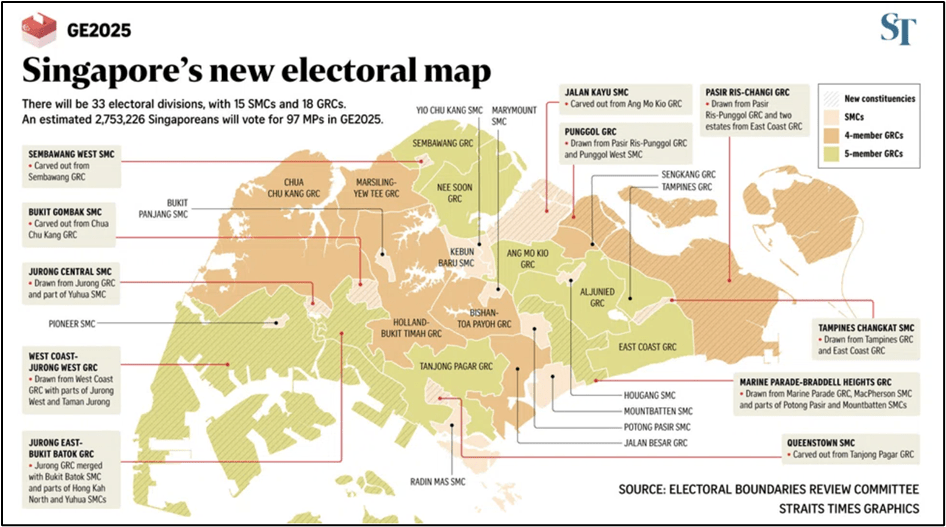
Pictured: A representation of the electoral map by The Straits Times, circa 2025
https://www.straitstimes.com/singapore/politics/ge2025-electoral-boundaries-announced-15-smcs-and-18-grcs
What is the difference between “GRC” and “SMC”?
GRCs are a type of constituency represented by more than one candidate. This is contrasted with Single Member Constituencies (“SMCs”), which are represented by just one.
Regardless of the team size, the GRCs (by law) must have a minority Indian or Malay Candidate.[1] GRCs can be in teams of 3-6 candidates for an area,[2] but the largest GRCs today comprise only 5 people.[3] This is following the call by former Prime Minister Lee Hsien Loong to downsize GRCs further to strengthen the connection between the MPs and the diverse residents of each constituency.[4]
Now that we understand how candidates may campaign for constituencies and become Elected parliamentarians, we now move to the second category, which concerns appointed members of Parliament.
Who serves within Parliament?
There are three categories of Members of Parliament (“MPs”). They are as follows:
- Elected Members of Parliament
Elected members are the candidates who campaigned in their respective GRCs and won the majority vote.
2. Non-Constituency Members of Parliament (“NCMP”)
The NCMPs are from an Opposition party which contested in the election, but did not win a seat in Parliament. The Constitution provides that there may be no more than 12 NCMPs at any time to represent parties that do not form the Government.[1] The number of NCMPs that can be elected follows the formula (12 – B), where B represents the number of elected opposition party candidates.[2] Following the 2025 General Election, there are two NCMPs from the WP. Presently, NCMPs have the same voting rights as elected MPs, despite having no majority mandate from the populace.
3. Nominated Members of Parliament (“NMP”)
The NMPs are non-partisan (meaning they belong to no party) and represent various fields within Singapore. They can be lawyers, consultants, psychiatrists, magazine editors or even professors.[3] NMPs can vote in Parliament on any bill or motion, except a bill to amend the Constitution; a supply bill, supplementary supply bill or final supply bill; a money bill; a vote of no confidence in the Government; and removing the President from office, though they may still debate on these motions. As a whole, the appointed MPs are meant to provide a sphere of diversity to the views in Parliament.[4]
As of 22 September 2025, there are a total of 99 MPs who have been sworn in as, and the breakdown is as follows: 97 elected members and 2 NCMPs.[5] This is the largest Parliament that has been confirmed to date. The Government is currently accepting nominations for NMPs until 6 November 2025.[6]
How are laws made?
Law-making is Parliament’s key function, and involves all persons residing within the country. Laws affect us every day —when we cross the road, buy food, or take a bus. Singapore’s system of creating laws is based on its British past, but we have since grown into our own. Every new law starts as a Bill. The government or individual MPs can suggest Bills, which are typically drafted by the Legislative division of the Attorney-General’s Chambers.[1] The Bill then goes through three stages in Parliament:[2]
- In the First Reading, the title of the Bill is read. No one has debated it yet, which gives everyone time to study the Bill.
- The Second Reading is where the real action happens. MPs discuss whether they like the Bill or not. They can suggest changes. If most MPs vote yes, the Bill moves forward. In the Committee Stage, MPs look at every line carefully. Sometimes, they ask the public what they think through the process of public consultations.
- The Third Reading is the final chance for debate before the Bill goes to the President to sign.
There is also a different type of law known as subsidiary legislation, which refer to rules and regulations made without needing to be debated in Parliament. They are necessary to allow for the Government to act on matters that require a high degree of flexibility. However, subsidiary legislation must not be inconsistent with any other law. The Readings of the Bill are all accessible online today, on a website called “Hansard – Parliamentary Debates”. This creates an official, word-for-word record of every session, keeping Parliament’s proceedings transparent and accountable to the public.
Who can be involved in law-making?
Everyone can be involved in the law-making process in Singapore. The key improvement to our political culture is that we have evolved to become more accessible to the ordinary man on the street. People can share their views about new laws by speaking to their MPs at the regular Meet-The-People sessions, or write to committees that study Bills. One such platform is Reach.Gov.SG, which invites the public to weigh in on possible Bills. There are also groups that care about the environment or workers’ rights who can try to influence new laws with evidence-backed recommendations for reform.[1] Singapore faces many new challenges that were not previously prominent, such as the increasing number of online threats, that require stronger laws governing issues within cybersecurity and online privacy. The burgeoning gig economy, with food delivery riders and private-hire drivers, may require new rules as well. The best way forward to ensure that the legislation adds value to the lives of citizens is to directly consult and engage them on how the law can help them, which is why the Government continues to consult the public through community channels to shape new legislation.
Conclusion
Looking ahead, Singapore must keep updating its law-making process to balance being quick and efficient with listening to different views, especially on contentious issues. It is vital as the individual to exercise your right to decide who you would like to have represent you, and to contribute your views on how amendments to the law will affect you.
Written by: Zoe Toh and Jason Lee
Year 4 LL.B. Student, JD Student
Singapore Management University, Yong Pung How School of Law
Citations list
Ang Hwee Min, “GE2025: Major boundary changes to West Coast, East Coast and Marine Parade GRCs”, Channel NewsAsia (11 March 2025) <https://www.channelnewsasia.com/singapore/ge2025-west-coast-east-coast-marine-parade-grc-electoral-boundary-changes-general-elections-4992546> (accessed 22 October 2025)
Attorney-General’s Chambers, “The Legislative Process” (25 June 2025) <https://www.agc.gov.sg/our-roles/drafter-of-laws/the-legislative-process/> (accessed 22 October 2025)
Constitution of the Republic of Singapore (2020 Rev Ed)
“Eight new NMPs to be appointed, Raj Joshua Thomas to serve second term”, Channel NewsAsia (17 July 2023) https://www.channelnewsasia.com/singapore/new-nmps-nominated-members-parliament-singapore-2023-3633581 (accessed 22 October 2025)
Elections Department Singapore, “Written Reply to Parliamentary Question on The Terms of Reference Provided to an Electoral Boundaries Review Committee (EBRC) and The Principles Underlying How Terms of Reference for EBRC Are Being Determined.” (2 July 2024) <https://www.eld.gov.sg/press/2024/Written%20Reply%20to%20PQ%20on%20The%20TOR%20Provided%20to%20an%20EBRC%20and%20The%20Principles%20Underlying%20How%20TOR%20for%20EBRC%20Are%20Being%20Determined.pdf> (accessed 22 October 2025)
Elections Department Singapore, “The Report of The Electoral Boundaries Review Committee, 2020” (13 March 2020) <https://www.eld.gov.sg/pdf/White_Paper_on_the_Report_of_the_Electoral_Boundaries_Review_Committee_2020.pdf> (accessed 22 October 2025)
Fabian Koh, “Parliament reopens with swearing-in of MPs; Speaker Seah Kian Peng warns against ‘playing to the gallery”, Channel NewsAsia (5 September 2025) <https://www.channelnewsasia.com/singapore/parliament-opening-seah-kian-peng-speaker-swearing-in-mp-ncmp-pap-wp-5334361> (accessed 22 October 2025)
Matthias Ang, “More GRCs in S’pore since 1988 but they’ve become smaller, explained,” Mothership (12 Mar 2025) <https://mothership.sg/2025/03/more-grcs-in-spore-since-1988-but-theyve-become-smaller-explained/> (accessed 22 October 2025)
Parliamentary Elections Act 1954 (2020 Rev Ed)
“Public invited to submit names for Nominated Members of Parliament”, Channel NewsAsia (7 October 2025) https://www.channelnewsasia.com/singapore/nominated-member-parliament-nmp-names-submitted-public-5387866 (accessed 22 October 2025)
Parliament of Singapore, “A Guide to Parliament of Singapore” <https://www.parliament.gov.sg/docs/default-source/default-document-library/fa_parliament-e-brochure.pdf?sfvrsn=7c8ab91c_2> (accessed 22 October 2025)
Shea Driscoll, “PM Lee Hsien Loong calls for smaller GRCs, more SMCs in next GE”, The Straits Times (27 January 2016), https://www.straitstimes.com/politics/pm-lee-hsien-loong-calls-for-smaller-grcs-more-smcs-in-next-ge (accessed 22 October 2025)
Singapore Legal Advice, “What is the Role of the Electoral Boundaries Review Committee (EBRC)?”, 30 May 2025, https://singaporelegaladvice.com/law-articles/role-electoral-boundaries-review-committee-ebrc/.
“Transient Workers Count Too” <https://twc2.org.sg/who-we-are/cause/> (accessed 22 October 2025)
-
Understanding the Rationale and Impact of the Sentencing Advisory Panel (SAP) Sentencing Guidelines for Scam-Related Offences
 SMU Constitutional Law and Criminal Justice Club