
Overview of the courts
In the earlier parts of this series, we have introduced the Executive and the Legislature. This final instalment in our 4-part series introduces the Judiciary, also known as the Courts. The Judiciary has the important power to resolve disputes. These disputes can involve both questions of fact (e.g. whether someone hit another person) and questions of law (e.g. whether that behaviour constituted a crime). As explained in Part 2, Parliament enacts legislation. However, it may not be obvious how legislation applies to a specific set of facts. When resolving disputes between parties, it is the task of the court to decide what the legislation exactly means. For example, even if the law states that one may be punished for intentionally causing hurt, the meaning of “intentionally” or “hurt” may not be clear and the court will need to interpret those terms before it can apply them to the facts of the case.
In addition, the courts can “make law” in situations that are not (yet) governed by legislation. One example of such judicially-created rules relate to the tort of negligence, where someone can claim compensation for damages caused by another person who has not shown the requisite care.
In Singapore, there are 3 broad categories of courts:
1. The Supreme Court
2. The State Courts
3. The Family Justice Court
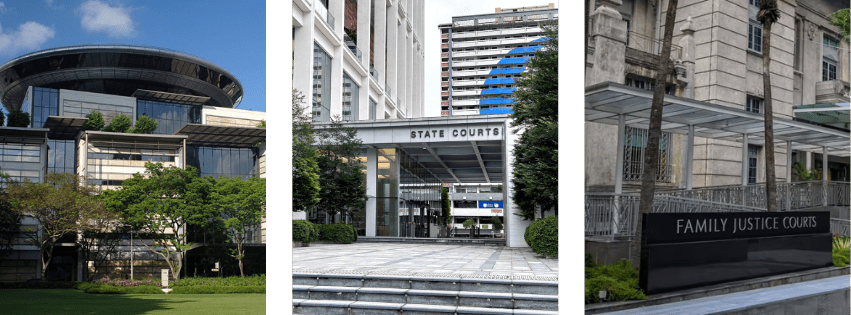
Each category comprises different courts that deal with different types of disputes. This article will only briefly cover the main courts in Singapore and does not aim to provide an exhaustive overview.
A. The Supreme Court

Broadly speaking, the Supreme Court consists of:
1. the Court of Appeal; and
2. the High Court.
Generally speaking, the High Court handles cases of considerable severity, such as cases of criminal offences punishable a term of imprisonment exceeding ten years or death. Thus, a person accused of murder would have their case heard in the High Court. The High Court also has an Appellate Division, which hears appeals from the General Division of the High Court, and the State Courts. As its name suggests, the Court of Appeal hears appeals from the High Court.
B. The State Courts

The State Courts deal with relatively smaller cases in terms of monetary value or type of criminal punishment. The State Courts include the District Courts and Magistrates’ Courts, which are general courts competent to deal with both criminal and civil cases (i.e. disputes between two individuals or businesses). The Magistrates’ Courts deal with smaller cases, such as criminal cases concerning charges where the maximum punishment is not more than 5 years’ imprisonment or a fine. The District Courts deal with relatively more serious cases.
The State Courts also includes among others the following specialised courts:
1. Coroners’ Courts;
2. Small Claims Tribunals;
3. Employment Claims Tribunals.
C. The Family Justice Courts
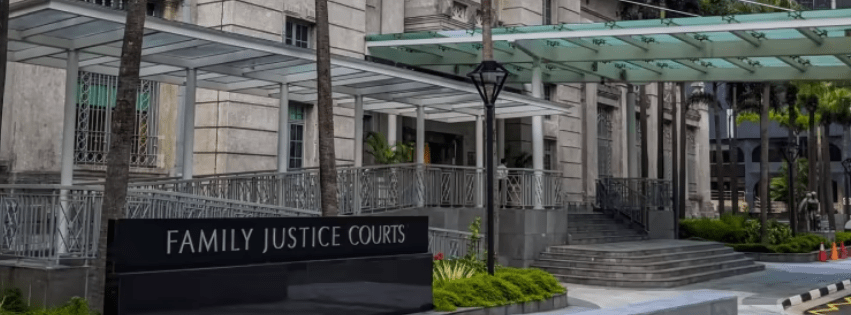
The Family Justice Courts consist of:1
1. the Family Division of the High Court;
2. the Family Courts; and
3. the Youth Courts.
The Family Division of the High Court (“FD”) and the Family Courts deals with family-related matters such as divorce and matrimony, appointment and control of guardians, child custody, and probates and wills. The FD generally deals with cases involving higher sums of money or questions of law, and appeals against decisions of the Family Courts or Youth Courts. As its name suggests, the Youth Court deals with family guidance, care and protection and youth arrest
Judicial power
When courts resolve disputes, it is important that their judgments are consistent with one another and that the right outcome is reached. Two mechanisms help to achieve these important aims:
Appeals
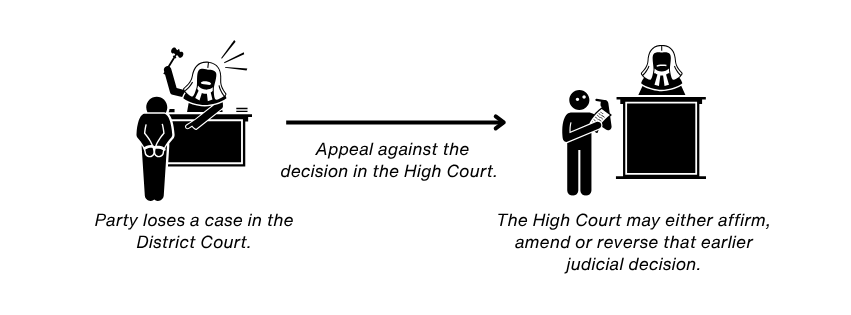
Parties to a dispute may be able to challenge decisions of a lower court before a higher court. During such appeals, the decision of the lower court is checked by the higher court for its accuracy. For instance, a party who loses a case in the District Court could appeal against the decision in the High Court. The High Court may either affirm, amend or reverse that earlier judicial decision.
Stare decisis
The decision of a higher court must be followed by lower courts. This is known as stare decisis, which means judges must align themselves with the reasons given by the court in past cases in arriving at their decisions.9 Hence, returning to the earlier example of deciding on the meaning of “intentionally”, if the Singapore Court of Appeal has adopted a certain definition of “intention”, lower courts must adopt that same definition. This is to ensure consistency in how the law is interpreted. However, courts are not bound by decisions made by other courts of the same level.
Judicial review
Apart from applying the law to disputes brought before them, the judiciary also performs another important function, known as judicial review. During judicial review, the Court considers the legal validity of a decision taken by the Executive or Parliament.
For example, a hawker applies to register as a Registered Merchant under the CDC voucher scheme. However, he was rejected while the neighbouring stall owner, who applied at the same time, was accepted. If the hawker attempted to challenge the decision but failed, it may be possible for him to apply for judicial review of the decision to not allow his application to be a Registered Merchant.
Judicial review as applied to executive actions
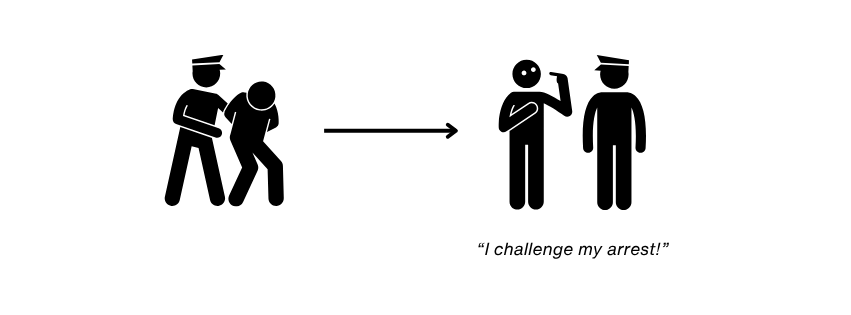
Actions taken by the Executive branch of government may be subject to judicial review. The court may consider whether the Executive was authorised to take the action in question, followed proper procedure in performing the action, and acted rationally. For example, say someone is arrested for an offence under the Miscellaneous Offences Act. In challenging their arrest, they could argue before the court that the police acted in an unlawful manner, had not adhered to proper procedure in making the arrest, or had acted irrationally in deciding to arrest them.
Some executive decisions concern areas that are beyond the judiciary’s typical area of expertise, such as foreign relations. The judiciary will avoid reviewing such issues of “high policy”, which are non-justiciable.
Judicial review as applied to legislation
Judicial review of legislation involves a court checking whether legislation violates one or more provisions of the Singapore Constitution. The most commonly made argument is that Parliament has infringed one or more of the fundamental liberties granted to individuals under the Constitution.
For example, in the recent case of Jumaat bin Mohamed Sayed and others v Attorney-General [2025] SGCA 40, the accused argued that certain sections of the Misuse of Drugs Act contravened his constitutional rights and were therefore unconstitutional. The relevant sections assume that an accused is trafficking drugs upon proving that the accused possessed a certain quantity of drugs. This was alleged to breach the right to life, which is subject to restrictions imposed by law, and the right to equality of all persons before the law. The Court of Appeal ultimately found that those sections were not unconstitutional, and accordingly dismissed the appeal.
Conclusion
The judiciary plays an important role in Singapore’s legal system by resolving disputes and ensuring that the other branches exercise their power lawfully. Hence, it is vital that the judiciary is independent from the parties to the cases before it as well as the other branches of state, which explains why there are strict rules governing the appointment and tenure of judges.
Written by: Joseph Vincent Lee and Tan Wan Kim
LL.B. Class of 2026, PLE Class of 2027
Singapore Management University, Yong Pung How School of Law
-
Understanding the Rationale and Impact of the Sentencing Advisory Panel (SAP) Sentencing Guidelines for Scam-Related Offences
- S 3 Family Justice Act. ↩︎
 SMU Constitutional Law and Criminal Justice Club