
What is covered in this article:
1. The Presidency: merely just a symbolic figure?
2. Starting Point: the Cabinet as the key executive body.
3. Statutory boards: planning and executing laws and policy directives from the Cabinet.
4. Attorney General and the Attorney General’s Chambers: The government’s lawyer?
The Cabinet: The Key Executive Body
The Cabinet represents the central decision-making body of the Singaporean government. It comprises the Prime Minister, Senior Minister(s), Deputy Prime Minister(s) and respective Ministry Heads. The Prime Minister, who is the leader of the party that has won the most votes in the General Elections, can appoint Members of Parliament (MPs) to spearhead various ministries.
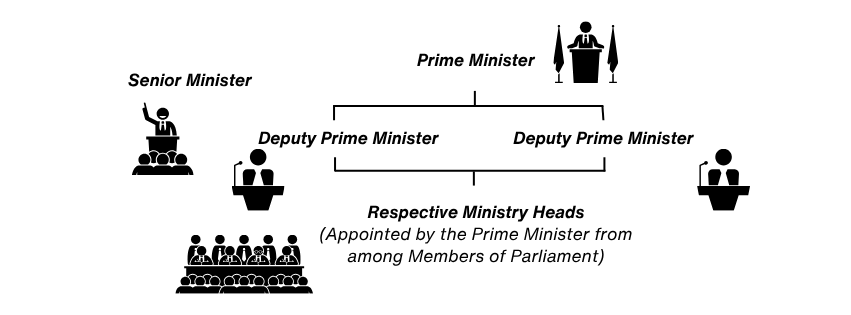
In essence, the Cabinet sets the legislative agenda and determines the composition of various ministries and, indirectly, statutory boards. This is seen in Chapter 2 of the Constitution of the Republic of Singapore (the “Constitution“). Article 23(1) of our Constitution vests the executive authority of Singapore in the President. Such executive authority is exercisable by the Cabinet in issuing executive orders or directing respective ministries to initiate the process of drafting laws. Strictly speaking, the power to make law is held by Parliament rather than the Cabinet. However, in practice, members of the Cabinet are also involved in making laws as they are also Members of Parliament.
Statutory Boards: Planning and executing laws and policy directives.
Statutory boards are bodies specifically constituted by the Cabinet to perform specific functions. Each statutory board has a constituting Act which lays out its powers, functions, and key governance requirements. In practice, statutory boards have significant autonomy over daily operations that they oversee; this allows for greater responsiveness to on-the-ground issues. Some statutory boards (like the Central Provident Fund Board) act in cooperation with the Ministry of Health and the Finance Ministry to invest the savings of Singaporeans for better returns. Other statutory boards are primarily regulatory in nature – for instance, the Accounting and Corporate Regulatory Authority and the Intellectual Property Office of Singapore regulate various corporate and intellectual property disputes. Certain statutory boards may be primarily employment-focused, such as SkillsFuture and Workforce Singapore.
The Attorney General and the Attorney General’s Chambers: The government’s lawyer
The Attorney General’s Chambers (AGC) wears various hats. He is the Government’s legal advisor, its drafter of laws, the public prosecutor, and its international law advisor. The Attorney-General’s Chambers (the “AGC”) is spearheaded by the Attorney-General and assisted by various deputies, known as Deputy Public Prosecutors, and the Solicitor General.
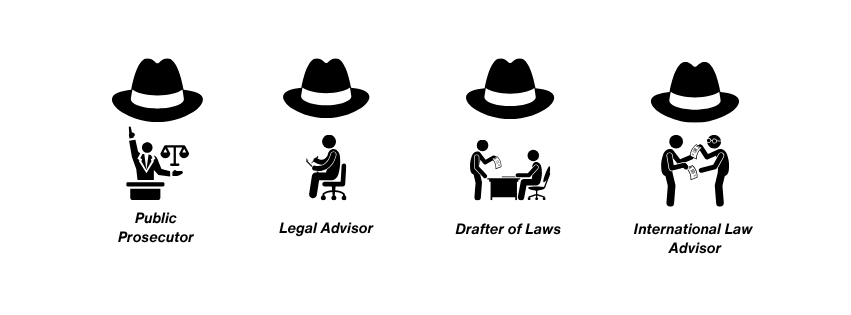
To wear its various hats, the AGC has four major divisions:
- The Civil Division provides legal advice to the Government, and performs other legal duties referred or assigned by the President or the Cabinet.
- Some issues that the Civil Division provides advice on include land acquisition, contracts, the conduct of elections, and appeals to Ministers under legislation such as the Electricity Act, Broadcasting Act and Competition Act.
- The Legislative Division is responsible for drafting legislation.
- Typically, this division is the starting point for legislative drafting. Once the Legislative Division completes a draft piece of legislation, it is sent to Parliament as a Bill to either introduce or amend existing legislation. Subsequently, Parliament will read and debate the bill multiple times, before it is sent to the President for final approval.
- The Crime Division acts as the Public Prosecutor for various crimes, and advocates for the position of the State against alleged offenders.
- In this regard, Article 35(8) of the Constitution allows the Attorney General the power to institute or discontinue proceedings for any offence.
- The International Affairs Division is responsible for providing legal advice on international law issues.
- This is particularly important to expand Singapore’s influence as a trading and investment hub, as well as representing Singapore internationally regarding stances on various sensitive international law issues.
The role of the President
Singapore, as a Westminster system, maintains a separation of powers between the President, who is the Head of State, and the Government, who is headed by the Prime Minister.
In Singapore, the President is both a symbolic and Constitutional actor. Symbolically, the President represents Singapore overseas as our highest foreign dignitary, and symbolises the nation in national celebrations and receiving foreign dignitaries. Constitutionally, the President has various powers such as appointing the Prime Minister, dissolving Parliament and withholding assent to certain Bills.
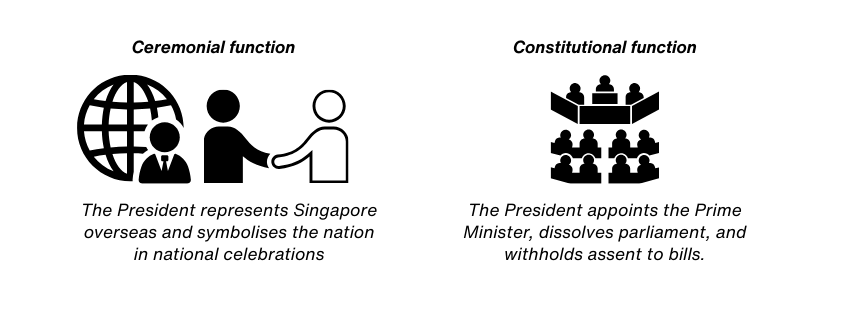
Under the Constitution, the President has two types of powers: discretionary and nondiscretionary powers.
When exercising discretionary powers, the President consults the Council of Presidential
Advisers. These discretionary powers allow the President to veto certain decisions such as:
1. Appointments to key public offices (such as the Chief Justice or Commissioner of Police);
2. The Expected Long-Term Real Rate of Return proposed annually by statutory bodies and government companies;
3. Supply Bills that draw on the Government’s past reserves; and
4. Legislation (subject to advice from the Presidential Council of Minority Rights).
The President’s discretionary powers provide an important check against governmental power. If the Government wished to restrict the President’s discretionary powers, it can only do so by amending the Constitution. However, in practice, it is rare to see Presidents proactively exercise their powers to withhold assent to Bills anyway.
The President’s non-discretionary powers can only be exercised on the advice of the Cabinet or a minister authorised by the Cabinet. For instance, the President can only exercise the power to pardon a criminal convicted of an offence on the advice of the Cabinet.
Written by: Lai Chee Yuen
Year 4 LL.B. Student, Singapore Management University, Yong Pung How School of Law
References
Constitution of the Republic of Singapore (2020 Rev Ed, 1999 Reprint) Articles 25, 28, and 30
“Explanatory Material on the Role of the President under the Constitution of the Republic of Singapore”
Singapore Parliamentary Debates, Official Report (8 Jan 2018), vol 94 (Ong Ye Kung, Minister for Education (Higher Education and Skills) and Second Minister for Defence)
Attorney-General’s Chambers, “Organisation Structure”
Attorney-General’s Chambers, “Overview of AGC”
Attorney-General’s Chambers, “Overview of Functions”
“Presidential Elections” “President’s Roles”
Constitutional Reference No 1 of 1995 [1995] 1 SLR(R) 803
-
Understanding the Rationale and Impact of the Sentencing Advisory Panel (SAP) Sentencing Guidelines for Scam-Related Offences
 SMU Constitutional Law and Criminal Justice Club