
The foundation of a democracy is to build a society based on “justice and equality”.1 To respect equality between persons, governmental power must be distributed ensure no king nor class of citizens can impose their will onto others.
To ensure this balance, democracies split power amongst three branches.2 First, the Legislature (or Parliament) debates, passes, and amends laws. Second, the Executive, under the leadership of the President, enforces laws. Lastly, the Judiciary, through the various courts, interprets laws and determines if they have been broken.3
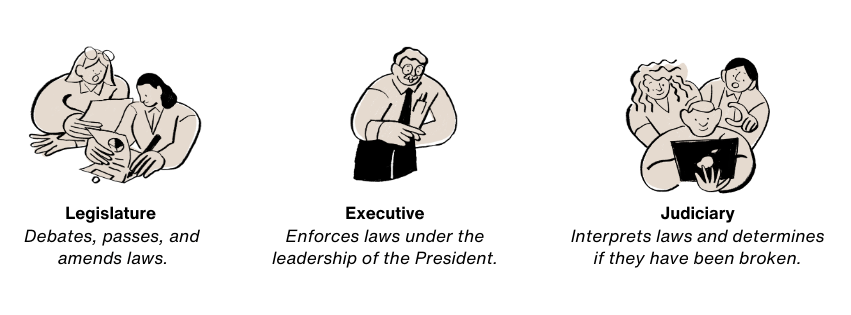
Dubbed the “separation of powers”, such power splitting is a longstanding pillar of democracy, beginning in England in the 1700s and from there, becoming the standard across the world.4 However, despite the label of “separation”, the legal process instead ties all three branches together to ensure that laws are followed through in Singapore, and that their intended normative effect is realised.
As an example, let’s examine how these distinct branches of government work together to create and enforce the recent Protection Against Online Falsehoods and Manipulations Act, or POFMA.
POFMA begins at the Legislature, where the process of lawmaking starts.5 Typically, a Minister introduces a draft law, known as a Bill, to the rest of Parliament. These bills are read thrice in Parliament. On the first and second readings, the Bill is debated by the Members of Parliament (MPs), who ask questions or propose amendments. Once this is completed, a vote to pass the law is conducted on the Third Reading. If more than 50% of the MPs present vote for the Bill, it is passed. Finally, the President must sign off on the Bill for it to become law.

POFMA was introduced in Parliament on 1 April 2019, by the Minister of Law.6 It was read three times, on 1 April 2019, 7 May 2019, and 8 May 2019. The long gap between the first and second readings gives the Ministry of Law time to make amendments to the Bill. At the third reading, 72 MPs voted in favour of the Bill, allowing it to pass.7 President Halimah Yacob then assented to the Bill, allowing it to enter into effect.8
Select Committees
For Bills that warrant special attention such as POFMA, Parliament can convene a Select Committee to review the Bill.9 Such Bills likely raise sensitive concerns such as potential overreaches of privacy, which would require expert testimony or additional documentation to ensure that Parliament is sufficiently well-versed on the topic to vote on it. After conducting their research, the Select Committee will present a report to Parliament about their findings.
How are MPs chosen?
But how are MPs chosen?10 In Singapore, the candidates with the highest percentage of votes are selected. Candidates can run for election individually or in a group, forming a Group Representation Constituency (“GRC”). After voting, the candidates in the group with the highest percentage of votes become MPs. There are two other forms of MPs – non-constituency Members of Parliament (“NCMPs”) and Nominated Members of Parliament (“NMPs”).11 NCMPs are the “best losers” in an election – they have the highest percentage of votes from the unelected candidates. NMPs are not associated with any political party but are appointed by the President upon the recommendations of a Select Committee.

Once a law is passed, the Executive administers the law and ensures that the law is followed. The Executive comprises the President, Cabinet and the Attorney General.12 Together, they are responsible for enacting government policies which enforce laws and ensure smooth administration of the nation’s daily affairs.
The Cabinet
The Cabinet is formed by Ministers who head different ministries and statutory boards.13 They are led by the Prime Minister, who is the MP who commands the confidence of the majority of the MPs. These Ministers are appointed from the MPs by the President, who is advised by the Prime Minister. While the Cabinet controls the Government, it is still accountable to Parliament. For instance, the Cabinet has previously invoked POFMA in response to 5 cases of misinformation spread regarding the 2020 General Elections.14 This, however, does not mean that POFMA is used lightly. The Cabinet has stated that there are rigorous processes that take place before POFMA is invoked.15 A Minister must approve the invocation of POFMA.16
The Cabinet also has the power to create subsidiary legislation, which are a set of rules and regulations to ensure the smooth functioning of the main law. In POFMA’s case, there are two pieces of subsidiary legislation – the Protection from Online Falsehoods and Manipulation Regulations 2019, and the Protection from Online Falsehoods and Manipulations Order 2019.17, 18 Unlike primary legislation, these do not have to be debated in Parliament and approved by the President.19
Unfortunately, Parliament cannot legislate for every kind of scenario that might occur, or some citizens intentionally or otherwise, run afoul of the law. In such situations, the Judiciary, which comprises Singapore’s courts, help to interpret what the written law means. Judges hear disputes arising between parties and decide on an outcome (i.e. a ‘judgement’, or a ‘decision’) for the parties.
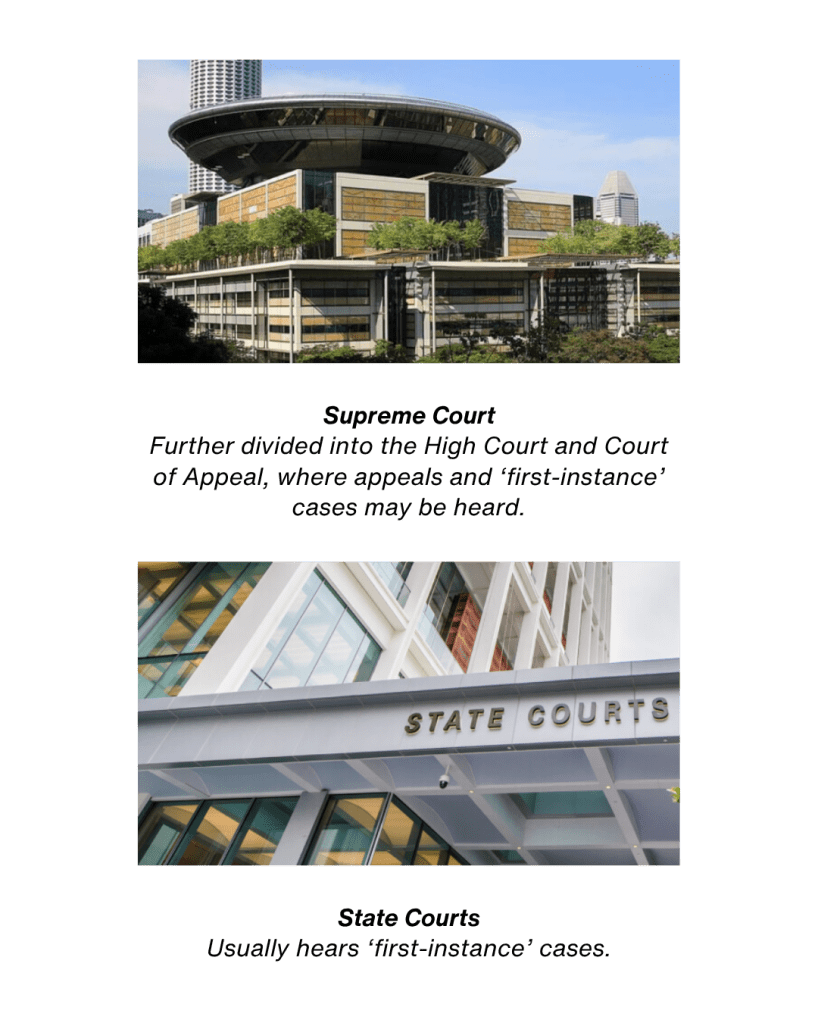
There are two types of courts: the State Courts and the Supreme Court. The Supreme Court is further divided into the High Court and the Court of Appeal. The Court of Appeal hears appeals from the High Court, which in turn, hears appeals from the State Courts. The High Court can also hear ‘first-instance’ cases, which are cases that appear for the first time at the High Court.
Judges apply the law by drawing from different sources of law such as statutes or previous court decisions. They then decide whether a violation has occurred. When an allegation under POFMA has been made, it is up to the courts to determine whether a violation has occurred by objectively determining the falsity of the statement.
The President plays a unique role in both the Legislature and the Executive.
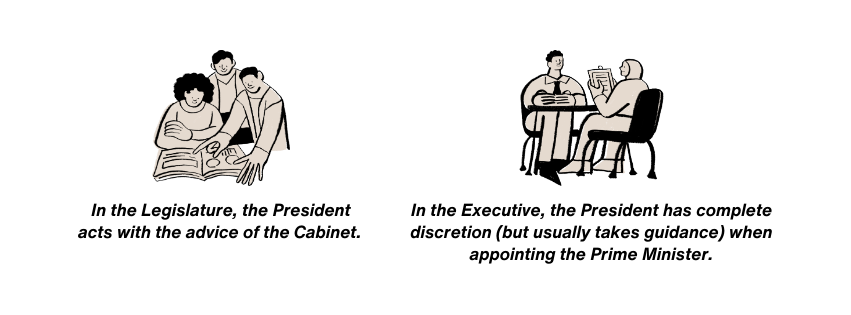
In the Legislature, the President must assent to passed Bills for them to officially become law. The President acts with the advice of the Cabinet, or with a Minister with the authority of the Cabinet.20 They are also advised by other Councils, such as the Council of Presidential Advisers, the Presidential Council for Religious Harmony, and the Presidential Council for Minority Rights.21-23 These Councils review Bills before it is passed to the President for their assent.
In the Executive, the President has complete discretion when it comes to appointing the Prime Minister. In practice, however, they will likely take guidance or advice from other stakeholders. The President also possesses other ancillary powers, such as the Presidential Pardon, where suitable offenders may be absolved of offences if the President sees fit.24 However, this discretion is not complete, as they must still act on the advice of the Cabinet.
The Attorney-General (“AG”) assists both the Legislature and Executive.25
In the Legislature, the Legislative Division of the Attorney-General Chambers is responsible for translating policies into Bills, which then become legislation after being approved by Parliament.26

In the Executive, the AG acts as the Government’s legal adviser.27 He is appointed by the President on the advice of the Prime Minister. As the Government’s lawyer, he cannot provide legal advice to anyone other than the Government and its Ministries.28 All actions by or against the Government are made in the name of the AG – for instance, the POFMA suit between the Government and The Online Citizen is stylised as The Online Citizen Pte Ltd v Attorney-General, rather than against a specific Minister.
Overview
If you asked someone about the branches of government and what they do, you’ll likely be hit with “aiyah, same same but different ah” – if you asked us, we’d say the same too; all three branches serve the same goal of protecting Singapore’s democratic values, just that they do so in their unique ways through their own institutions. In our following publications, we will examine each of the branches in more detail.
Written by: Janae Kwan
Year 3 LL.B. Student, Singapore Management University, Yong Pung How School of Law
Citations:
- National Heritage Board. (2025). National Pledge. Goverment of Singapore, National Heritage Board. https://www.nhb.gov.sg/what-we-do/our-work/community-engagement/education/resources/national-symbols/national-pledge
- Parliament of Singapore. (2024, March 12). System of Government. Government of Singapore, Parliament of Singapore. https://www.parliament.gov.sg/about-us/structure/system-of-government
- Singapore Courts. (2021, August 12). About the Legal System. Government of Singapore, Singapore Courts. https://www.judiciary.gov.sg/who-we-are/about-legal-system
- Montesquieu, The Spirit of Laws (1748), p 186
- Attorney-General’s Chambers. (2025, June 25). The Legislative Process. Government of Singapore, Attorney-General’s Chambers. https://www.agc.gov.sg/our-roles/drafter-of-laws/the-legislative-process/
- Protection from Online Falsehoods and Manipulation Act Bill. (Bill No. 10/2019)
- Singapore Parliamentary Debates, Official Report (8 May 2019) vol 94 https://sprs.parl.gov.sg/search/#/sprs3topic?reportid=bill-367
- POFMA Office. (2025, October 8). Information about POFMA. Open Government Products, POFMA Office. https://www.pofmaoffice.gov.sg/resources/
- Parliament of Singapore. (2024, April 3). Select Committee on Deliberate Online Falsehoods – Causes, Consequences and Countermeasures. Government of Singapore, Parliament of Singapore. https://www.parliament.gov.sg/sconlinefalsehoods
- Parliament of Singapore. (2025, May 7). Members of Parliament. Government of Singapore, Parliament of Singapore. https://www.parliament.gov.sg/about-us/structure/members-of-parliament
- Constitution of the Republic of Singapore. Article 39(1).
- Constitution of the Republic of Singapore. Articles 23, 24 and 35.
- Constitution of the Republic of Singapore. Article 24.
- Ng, J. S. (2024, October 4). Views stay divided on POFMA five years on, but has it helped in tackling fake news? Channel NewsAsia. https://www.channelnewsasia.com/today/ground-up/pofma-fake-news-online-falsehoods-five-years-4656361
- Ng, J. S. (2024, October 4). Views stay divided on POFMA five years on, but has it helped in tackling fake news? Channel NewsAsia. https://www.channelnewsasia.com/today/ground-up/pofma-fake-news-online-falsehoods-five-years-4656361
- POFMA Office. (2025, October 8). Reporting Potential Falsehoods. Open Government Products, POFMA Office. https://www.pofmaoffice.gov.sg/report-falsehoods/
- Protection from Online Falsehoods and Manipulation Regulations 2019
- Protection from Online Falsehoods Manipulation (Exemption from Sections 21(2)(a) and (b) and 22(2)(a)) Order 2019
- Beckman, R. (March 2005). The Role of Scientists, Experts and Stakeholders in the Law-Making Process in Singapore. https://cil.nus.edu.sg/wp-content/uploads/2010/10/Beckman-Role-of-Scientists-Experts-and-Stakeholders-in-Law-Making-Process-in-Singapore.pdf
- Constitution of the Republic of Singapore. Article 21(1).
- President of the Republic of Singapore. (2025, October 23). Council of Presidential Advisers. President’s Office, President of the Republic of Singapore. https://www.istana.gov.sg/Presidents-Office/Council-of-Presidential-Advisers
- President of the Republic of Singapore. (2024, July 16). Other Presidential Councils. President’s Office, President of the Republic of Singapore. https://www.istana.gov.sg/Presidents-Office/Council-of-Presidential-Advisers
- President of the Republic of Singapore. (2024, July 16). Other Presidential Councils. President’s Office, President of the Republic of Singapore. https://www.istana.gov.sg/Presidents-Office/Council-of-Presidential-Advisers
- Constitution of the Republic of Singapore. Article 22P.
- Singapore Courts. (2021, August 12). About the Legal System. Government of Singapore, Singapore Courts. https://www.judiciary.gov.sg/who-we-are/about-legal-system
- Attorney-General’s Chambers. (2025, June 30). Overview of Functions. Government of Singapore, Attorney-General’s Chambers. https://www.agc.gov.sg/our-roles/drafter-of-laws/overview-of-functions/
- Attorney-General’s Chambers. (2025, June 24). Overview of Functions. Government of Singapore, Attorney-General’s Chambers. https://www.agc.gov.sg/our-roles/government-legal-advisor/overview-of-functions/
- Attorney-General’s Chambers. (2025, June 19). Frequently Asked Questions. Government of Singapore, Attorney-General’s Chambers. https://www.agc.gov.sg/faq/
-
Understanding the Rationale and Impact of the Sentencing Advisory Panel (SAP) Sentencing Guidelines for Scam-Related Offences
I. INTRODUCTION Between 2022 and 2023 alone, the number of reported scam cases rose by nearly 50%, involving a total amount of $651.8 million. Over the past five years, there has been more than a sevenfold rise in scam cases, accompanied by a fourfold increase in financial losses. In response, Parliament enacted amendments to the…
 SMU Constitutional Law and Criminal Justice Club