
Introduction
Have you ever received a traffic fine, applied for a HDB flat, or signed an employment contract? What about relying on laws that protect you from scams, or ensure that your will is honoured? Have you ever wondered how these rules came to be, or why they can be enforced on you in the first place?
The answer can be traced back to a single, powerful document: the Constitution of the Republic of Singapore.[1] Any country hoping to maintain order and stability needs clear rules on who is entitled to exercise power and how such is done; it is one of the core functions of a constitution to do precisely that. In essence, a constitution is “a collection of rules that determine the creation and operation of a government and its institutions”.[2] This text shapes our daily lives in Singapore, undergirding answers to critical questions such as: Why can the state acquire land for public housing? Why are citizens able to practise their religion freely?
This article traces how Singapore’s Constitution came to be, the essential functions it serves, and, crucially, why it matters in the lives of ordinary Singaporeans. It concludes by inviting deeper reflection on what ultimately gives our Constitution its power.
How did Singapore get its Constitution?
Different from what happened in many other countries, the Singapore Constitution was not born out of a revolutionary “founding” moment. Instead, it was assembled from various documents adopted throughout the course of our nation’s history, which were eventually consolidated into a single document. Before independence, Singapore was governed under the British colonial system.[3] In 1959, the country achieved self-government and a new written State Constitution was brought into existence.[4] Self-government was followed by merger with Malaysia in 1963, during which time the Malaysian Federal Constitution applied to the territory of Singapore.[5] When Singapore separated from Malaysia in 1965, it took on a makeshift Constitution as a newly independent state. This Constitution comprised three documents: the 1963 State Constitution, the Republic of Singapore Independence Act 1965, and selected portions of the Malaysian Federal Constitution incorporated through the Singapore Independence Act 1965.[6] In 1980, the Attorney-General issued a reprint of what is now the Singapore Constitution — consolidated into a single, composite document for the first time.[7]
What is the Constitution for?
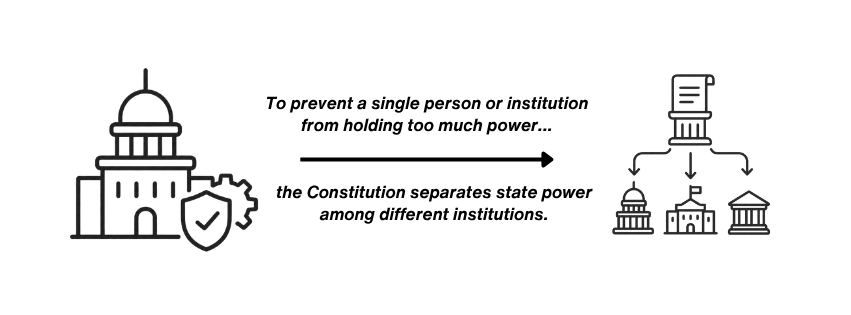
Power is centralised in the State to facilitate effective administration.[8] However, allowing a single person or institution to hold too much power creates the risk of abuse.[9] One of the Constitution’s core functions is therefore to separate state power between different institutions. In Singapore, as in many other countries, governmental power is roughly divided into three categories and allocated to different institutions: the power to create laws is vested in the Legislature,[10] the power to enforce those laws is vested in the Executive,[11] and judicial power is vested in the Judiciary.[12] By avoiding the concentration of power in a single body or institution, the Constitution helps circumvent oppression and arbitrary rule. For a deeper dive, readers may refer to our article series on the separation of powers.[13]
Another key function of the Constitution is to safeguard fundamental rights. Part 4 of the Constitution enshrines freedoms such as freedom of speech and equality before the law. However, these freedoms are not absolute and unconditional. Rather, they can be limited to achieve other important objectives like public order, security, and morality.
Finally, the Constitution is more than just a legal document; it is also an expression of national identity, thereby symbolising the people’s core values.[14] An example lies in Article 156 of the Singapore Constitution, which discusses the institution of marriage.[15] In particular, subsections (3) and (4) provide that nothing in Part 4 of the Constitution would invalidate a law or exercise of authority, respectively, on the sole ground that marriage is as a union between a man and a woman. One may argue that this provision entrenches a norm in favour of heterosexual monogamous marriage, thereby reflecting the conservative social values of our nation.
Constitutional supremacy
The Constitution is the “supreme law” of Singapore,[16] or the highest legal text. This means that all other laws in Singapore — including Acts of Parliament like the Penal Code and subsidiary legislation such as Housing Development Board rules — must comply with the Constitution. Otherwise, they are void to the extent of the inconsistency. To ensure compliance with the Constitution, it is possible to bring challenges against specific laws and argue that (part of) those laws breach one or more provisions of the Constitution. This happened, among other cases, in relation to the now-repealed section 377A of the Penal Code.[17]
In a similar vein, the Constitution performs an entrenchment function by protecting the fundamental rules governing society (such as the freedom of religion, but also institutional arrangements) from legal changes that could arise due to short-term political pressures and incentives. In turn, this fosters confidence in citizens that society’s foundational principles are secure and enduring.
For this same reason, the amendment process for the Constitution is more rigorous as compared to the adoption of ordinary laws.[18] Ordinary legislation can be amended by a simple majority. In contrast, amending the Constitution requires at least a two-thirds majority of all elected Members of Parliament.[19] This high threshold means that any changes to the Constitution require broad political support.[20]
The force behind our Constitution
Key processes in society such as general elections for Parliament often spark public discussion about democratic choice, government power and accountability. Yet the legal rules underlying these processes are rarely questioned. This points to a deeper question: why do we all agree to play by the constitutional rulebook? Why do we accept the Constitution as binding, and what is the source of its power?
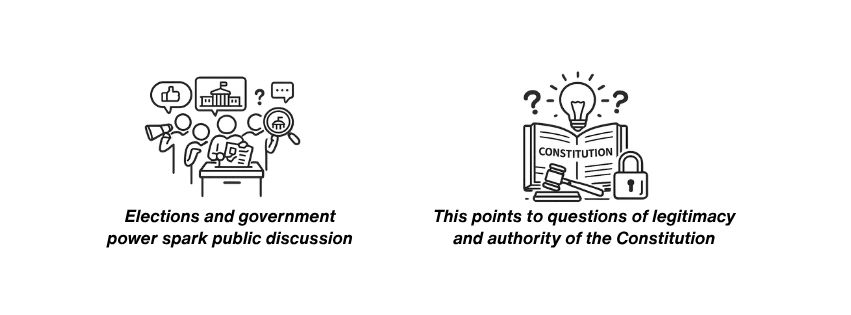
One important perspective in this regard is that the Constitution’s authority derives from the sovereignty of the people. This is the idea that political power ultimately rests with the people, who create and sustain government through their elected representatives, particularly in a representative democracy like Singapore.[21] Following this, the Constitution has force because citizens broadly accept it as the basic set of rules governing society, and as the foundation of how we choose to constitute ourselves as a nation. This acceptance is expressed in everyday life, whether through engaging with public institutions or expecting our fundamental rights to be respected. In this sense, the normative legitimacy of the Constitution is derived from Singaporeans themselves, and not merely from the fact that it was drafted by our founding fathers, or is enforced by our courts — although, as a matter of legal authority, the Constitution remains the supreme law.
Asking such questions is important, for a healthy democracy requires its citizens to continually reflect on the source and conditions for the exercise of State power, which are located in the Constitution.
Conclusion
To understand and appreciate our Constitution is the first step towards engaged and informed citizenship. In Singapore, the Constitution may feel like a distant document, of interest primarily to lawyers and politicians. Yet, it matters because it is the very bedrock of our nation and silently undergirds our everyday lives.
Written by: Angel
Year 4 LL.B. Student
Singapore Management University, Yong Pung How School of Law
Edited by: Elizabeth Tan
Year 3 LL.B. Student
Singapore Management University, Yong Pung How School of Law
Citations List
[1] Constitution of the Republic of Singapore.
[2] The Law Society of Singapore. (n.d.). The Constitution of Singapore. https://www.lawsociety.org.sg/our-community/legal-fact-check/the-constitution-of-singapore/
[3] Singapore Law Watch. (n.d.). The Singapore legal system (Ch. 01). https://www.singaporelawwatch.sg/About-Singapore-Law/Overview/ch-01-the-singapore-legal-system
[4] Singapore Law Watch. (n.d.). The Singapore legal system (Ch. 01). https://www.singaporelawwatch.sg/About-Singapore-Law/Overview/ch-01-the-singapore-legal-system
[5] Federal Constitution of Malaysia. (n.d.). Malaysia Federal Legislation. Attorney-General’s Chambers of Malaysia. https://lom.agc.gov.my/federal-constitution.php
[6]The Law Society of Singapore. (n.d.). The Constitution of Singapore. https://www.lawsociety.org.sg/our-community/legal-fact-check/the-constitution-of-singapore/; National Library Board Singapore. (n.d.). Constitution of the Republic of Singapore is adopted. https://www.nlb.gov.sg/main/article-detail?cmsuuid=efec06b8-45e1-439e-8c9f-cd6c00cc5149
[7] The Law Society of Singapore. (n.d.). The Constitution of Singapore. https://www.lawsociety.org.sg/our-community/legal-fact-check/the-constitution-of-singapore/.
[8] Kevin Tan, The Singapore Legal System (NUS Press, 2nd Ed, 1999) at p 67.
[9] Kevin Tan, The Singapore Legal System (NUS Press, 2nd Ed, 1999) at p 67.
[10] Constitution of the Republic of Singapore. Article 38.
[11] Constitution of the Republic of Singapore. Article 23(1).
[12] Constitution of the Republic of Singapore. Article 93.
[13] Kwan, J. (n.d.). Separation of powers. SMU Constitutional Law and Criminal Justice Club. https://smuccjc.com/separation-of-powers/
[14] Singapore Legal Advice. (2024, January 24). How is the Constitution amended in Singapore? https://singaporelegaladvice.com/law-articles/constitution-amended-singapore/
[15] Constitution of the Republic of Singapore. Article 156.
[16] Constitution of the Republic of Singapore. Article 4.
[17] See Tan Seet Eng v Attorney-General and another matter [2015] SGCA 59.
[18] Singapore Legal Advice. (2024, January 24). How is the Constitution amended in Singapore? https://singaporelegaladvice.com/law-articles/constitution-amended-singapore/
[19] Constitution of the Republic of Singapore. Article 5(2).
[20] Singapore Law Advisory. (2025, October 6). Understanding the Constitution of Singapore: Creating state institutions, conferring individual rights and amendment. https://singaporelawadvisory.com/understanding-the-constitution-of-singapore/
[21] Morgan, Grace (ed.). A Guide to General Elections in Singapore. Singapore: SMU APolitical, 2015.
Available at http://ink.library.smu.edu.sg/studentpub/2
-
Understanding the Rationale and Impact of the Sentencing Advisory Panel (SAP) Sentencing Guidelines for Scam-Related Offences

