
In Singapore, the government and public bodies are conferred authority to carry out their duties in the public realm, serving the nation and its citizens. These powers are known as public powers, which the government exercises to make decisions. The exercise of public powers, called public decisions, is done all the time, affecting our daily lives in a multitude of ways. Some decisions only affect a single individual or family, such as a decision by the authorities to compulsorily acquire your home. Others, however, have much more far-reaching implications, impacting certain communities. For instance, this ranges from the police not permitting the playing of musical instruments during celebrations such as Thaipusam,[1] to dispersing public protests outside the CPF building.[2]
How do we ensure that Singapore’s decision-makers use their power lawfully? An important process in this regard is judicial review, which involves the courts examining exercises of public power.[3]
In this article, we will explore what judicial review is, how one can apply for judicial review and how the relevant proceedings are conducted.
Remedies obtained through judicial review
First and foremost, why would one apply for judicial review? If public power has been exercised unlawfully against an individual, a successful judicial review application would prevent the decision-maker from acting on the unlawful decision.
While a successful application does not mean that the courts will order monetary compensation for the applicant (though one may still seek monetary compensation by pursuing a claim in private law at the same time), there are several possible outcomes:
- Quashing order;
- Mandatory order;
- Prohibiting order; or
- Declaration.
Firstly, a quashing order sets aside a decision made by the public authority and declares it of no legal effect. This is the most common remedy given, and usually results in the public body having to take a new decision.[4]
Secondly, a mandatory order instructs the public authority to perform their duties under the relevant legislation.[5] Such duties may include the duty to consider complaints or process applications. Individuals may seek mandatory orders for the authority to fulfil these duties by, for example, reconsidering their complaints or applications.
Thirdly, a prohibiting order forbids the public authority from performing an act.[6] Examples include applications to stop authorities from disclosing an individual’s banking activity,[7] suspending a business’ operations, and other enforcement actions.
Lastly, a declaration is an authoritative statement made by the courts as to the legal position on the issue at hand. An applicant can seek a declaration that a finding by the public body is void, or that a certain act was unconstitutional. For instance, individuals who have had their properties gazetted for acquisition by the Collector of Land Revenue have applied for declarations that such acquisition violated the Constitution.[8]
Process of judicial review
An application for judicial review comprises two stages:
- Applying for leave for judicial review proceedings; and
- Assessing the grounds of judicial review.
A. Applying for leave
One must obtain permission from the competent court before one can submit an application for judicial review.[9] To do so, an applicant must satisfy five requirements: first, their application must not be overdue. Second, the decision in question must be one that can be reviewed by the courts. Third, the applicant must have sufficient interest in the decision. Fourth, they must have exhausted all other possible remedies. As a threshold requirement, the applicant must also have an arguable case of reasonable suspicion in favour of granting the remedies sought. These will be discussed in turn.
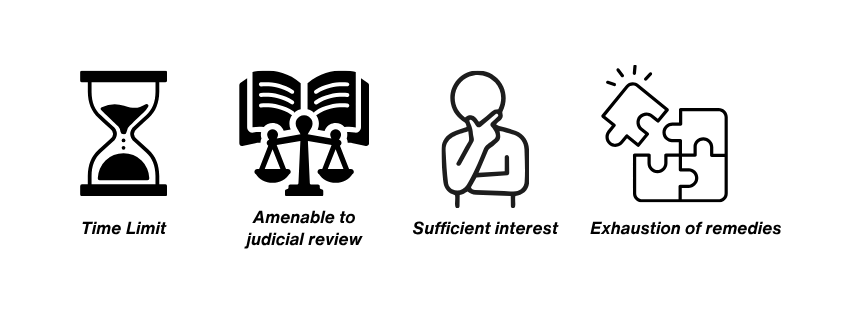
Requirement 1: Time limit
An application for leave must be made within three months from the date of the governmental action which the applicant seeks to review.[10] If the application is made after that three-month mark, the applicant must provide a satisfactory explanation for the delay.[11] In past cases, the courts have held that the explanation was satisfactory where applicants only found out about crucial information regarding the decision at a later date, or where the decision-maker indicated a willingness to reconsider its earlier decision.[12]
Requirement 2: Amenable to judicial review
For this requirement, the decision sought to be challenged must be either:
- Made in the exercise of a statutory power; or
- Made in exercise of a public function.
The court must first consider the source of the decision-maker’s power. If the source of power is found in an Act of Parliament or subsidiary legislation (that is, a written law), the decision may be subject to judicial review.[13] For instance, if the police arrest someone pursuant to a provision under the Miscellaneous Offences Act, the source of the power comes from a statute. Since the decision was made in exercise of public power, the decision to arrest is amenable to judicial review.
A decision may also be open to judicial review if it involves an exercise of public law functions. This is because non-public bodies may also make public decisions, and these are within the purview of administrative law. For instance, the SGX-ST’s public reprimand of listed company directors has been held to constitute an exercise of public law functions.[14] Firstly, the SGX-ST is an approved exchange governed by the Securities and Futures Act.[15] Its membership and listing rules which enable the public reprimand function have also been properly enacted in accordance with that statute.[16] This forms a statutory basis for the SGX-ST’s public reprimand function. Secondly, the SGX-ST, being a crucial aspect of Singapore’s financial sector in operating a securities market on an open and global scale, may have far-reaching implications on a business’s reputation or a director’s continued service on board committees by listing individuals on its public reprimand.[17] Therefore, the combination of statutory underpinnings behind a decision-making power together with its public nature renders a decision open to judicial review.
At the same time, just because the decision-maker is a public body this does not mean that the decision is necessarily public in nature and thus amenable to judicial review. For instance, the termination of employment of an individual by a public body would not be considered a public decision. Although the employer is a public authority, employment is a private matter of contract between the employer and employee.
Nonetheless, whether the decision was made in exercise of a statutory power or public function is not the end of the inquiry. Even if the above is met, the court may not grant permission for judicial review if the decision has no legal effect. For instance, if the decision concerned is merely a warning, such a decision has no legal effect as it does not affect the applicant’s legal rights and interests.[18]
Furthermore, the courts may not grant permission for judicial review if the decision concerns areas that the courts consider immune from review. This is as certain areas of governmental decision-making involve issues of “high policy”, requiring consideration of heavily political questions which the courts may not be well-equipped to tackle.[19] These areas are considered non-justiciable, where the courts acknowledge that such decisions should be left to the expertise of the public body. Some examples include dissolving parliament, foreign affairs and national defence matters.[20] If a decision concerns such areas, the courts will not grant permission to commence judicial review proceedings.
Requirement 3: Sufficient interest
Next, an applicant seeking leave to commence judicial review proceedings must show that she has legal standing in bringing the action.[21] Not just anyone can make an application – to prevent wastage of the court’s time and resources, those seeking the court’s permission to apply for judicial review must have sufficient interest in the matter.[22]
Typically, such interest is considered present if the applicant’s rights are being violated by the decision concerned. While a violation of constitutional rights is most apparent where the applicant is facing prosecution, such violation may also be found where there is merely a threat of prosecution, as the law affects individuals even where they are not being prosecuted.[23] Take the now-appealed s 377A of the Penal Code for an instance. In the past, homosexual males seeking to challenge the constitutionality of s 377A were deemed to have sufficient interest in the matter as there was a real and credible threat of prosecution under the provision.[24]
Even in the absence of their personal right being affected, an applicant may still have a sufficient interest if she can show that she has a public right, or that it is in the public interest to review the decision. To establish a public right, an applicant must prove that she has sustained “special damage” as a result of the decision, affecting the applicant more directly than others, distinguishing her claim from that of other potential applicants in the same class.[25] Consider a decision by the Land Transport Authority to close a public road – everyone loses access to it. An unhappy shop owner whose store’s only entrance is on that road suffers business losses when potential customers are unable to enter the store. Compared to others who are simply unable to enjoy the convenience of using the road, this potential applicant (the shop owner) sustains “special damage” in the form of business losses which others may not incur.
As for public interest, the applicant must show that the decision-maker has breached its public duty in an egregious manner.[26] For instance, if a Cabinet Minister allegedly abuses his wide-ranging powers, this may amount to an exceptional instance of a grave and serious breach of legality. On the other hand, if a low-level government officer fails to execute his duties fully, this would not concern an egregious breach of public duty, such that it would be in the public interest to hear the matter.[27]
Requirement 4: Exhaustion of remedies
Lastly, an applicant seeking judicial review must exhaust all alternative remedies before applying for judicial review. In considering whether remedies have been exhausted, the courts will only look at those reasonably within the applicant’s means. For instance, where the applicant is unsatisfied with the decision, they are sometimes allowed to appeal to the Minister or the authority to reconsider.[28] If this is available but not done, the application for leave would likely be rejected.
B. Grounds of judicial review
Even if permission from the court is successfully obtained, the court will only review the application (and if successful, grant one of the orders mentioned earlier) on limited grounds, such as the following:
- Illegality;
- Irrationality; and
- Procedural impropriety.

Illegality
The court can quash a decision if it was made illegally. Some ways in which a public body may act illegally include:
- Acting outside its scope of power; and
- Acting in bad faith.
For the first, public authorities derive their powers largely from statute. For instance, under Section 23 of the Public Order and Safety Act, a police officer may search a vehicle without a warrant if they reasonably suspect that it is the target of a special authorisation, whereby the police have been granted special permit to prevent the occurrence of terrorist acts, acts of violence affecting the public and more.[29] Suppose the target vehicle of a criminal investigation is a red van, yet an officer searches a blue car with no connection to the investigation, the officer likely exceeded their statutory powers to search.
More severely, a public authority may act illegally if it exercises its discretion in bad faith. This could include intentionally abusing its power, or being reckless as to whether it did so. Fortunately, this occurs only in rare instances.
Irrationality
Judicial review applicants may also challenge executive decisions by arguing that the authority’s decision is so defiant of logic that no reasonable authority would make such a decision.[30] This standard is extremely hard to meet, and only in rare cases will the courts find that a decision has been irrational. For instance, in the context of collective sale, if the Strata Titles Board (“STB”) decides to hear an application after its own imposed deadline to obtain STB approval, this is considered irrational and fulfils this ground of judicial review.[31]
Procedural impropriety
Public decisions can also be challenged on the grounds that the proper procedure was not followed. This can be established in two ways:
- The public authority did not follow the proper procedure in making its decision; and
- The public authority made its decision in breach of rules of natural justice.
Procedural defects
This ground entails assessing whether the public authority has adhered to the procedural requirements for the relevant decision-making process. Failure to comply with a mandatory procedure would satisfy this ground. However, if the procedure is meant to act as a guideline only, non-compliance will not amount to procedural impropriety. To discern this, the courts will analyse the statute and determine whether the legislators intended for the procedure to be binding. For instance, if a statute is silent on the consequences of non-compliance with the stipulated procedure, or if strict insistence on compliance may lead to an impractical result, the courts are likely to find that the procedure at hand is merely a guideline.[32]
Another facet of procedural impropriety is the concept of legitimate expectations. Has an authority ever promised to give or do something but did not follow through? Indeed, if the decision-making authority has made a clear promise to an applicant that certain procedures will be followed, the latter can reasonably expect for it to be fulfilled. For instance, if the public body has promised to conduct consultations before a decision is made, the applicant may reasonably expect to be engaged in dialogues before it makes a decision. Likewise, if there has been a regular practice pertaining to the decision-making process which is not followed in the case of the applicant, this may also satisfy the ground of procedural legitimate expectations, as the applicant could reasonably expect that this practice also applies to their case.
Natural justice
This ground can be established where the decision-maker has not granted the applicant a fair hearing, or when the decision-maker has exhibited actual, imputed or apparent bias against the applicant.
Firstly, persons subjected to any form of decision-making by a panel, such as a court, tribunal or disciplinary committee empowered to make decisions affecting them, are entitled to a fair hearing. This may consist of a right to be heard, having sufficient time to prepare responses, access to documentation and more. For instance, if the panel interferes excessively, preventing the applicant’s opportunity to present their case, this could amount to depriving the applicant of a fair hearing.
Secondly, the rule against bias may operate to render an authority’s decision procedurally improper. This can be established where the decision-maker is influenced by bias or prejudice, or if there is a conflict of interest.
Reflections
Given the potentially wide-reaching implications that decisions made by public authorities may have on our daily lives, it is important to know the possible recourse individuals may have against those decisions that are believed to be unlawful. This is especially so because these decisions could touch on personal aspects of our lives and well-being, such as religion, home-ownership, and the running of a business.
When deciding whether to apply for judicial review, one should be aware of the relevant procedure, applicable grounds of review, as well as possible issues the application might face. In general, the courts in Singapore are careful to avoid intruding into the Executive’s realm of authority. At the same time, integrity in the exercise of decision-making powers must be upheld. Therefore, administrative law is a sensitive yet crucial area of law that is needed to ensure legality, protection of constitutional rights and effective governance.
Written by: Sherwin and Megan
Year 3 LL.B. Students
Singapore Management University, Yong Pung How School of Law
Edited by: Jemimah
Year 4 LL.B. Student
Singapore Management University, Yong Pung How School of Law
Citations List
[1] Vijaya Kumar s/o Rajendran v Attorney-General [2015] SGHC 244 <https://www.elitigation.sg/gd/s/2015_SGHC_244>.
[2] Chee Siok Chin v Minister for Home Affairs [2005] SGHC 216 <https://www.elitigation.sg/gd/s/2005_SGHC_216>.
[3] Yeap Wai Kong v Singapore Exchange Securities Trading Ltd [2010] SGHC 103 at [28] <https://www.elitigation.sg/gd/s/2012_SGHC_103>.
[4] IPSEA, (n.d.). Judicial review. <https://www.ipsea.org.uk/judicial-review>.
[5] Singapore Legal Advice, (October 22, 2025). Judicial Review in Singapore: What is It and How to Apply. <https://singaporelegaladvice.com/law-articles/judicial-review-singapore-apply/>.
[6] Singapore Legal Advice, (October 22, 2025). Judicial Review in Singapore: What is It and How to Apply. <https://singaporelegaladvice.com/law-articles/judicial-review-singapore-apply/>.
[7] AXY v Comptroller of Income Tax [2015] SGHC 291 <https://www.elitigation.sg/gd/s/2015_SGHC_291>.
[8] Eng Foong Ho v Attorney-General [2009] SGCA 1 <https://www.elitigation.sg/gdviewer/s/2009_SGCA_1>.
[9] Rules of Court 2021 Order 24 rule 5(1) <https://sso.agc.gov.sg//SL/SCJA1969-S914-2021#P11-PO24->.
[10] Rules of Court 2021 Order 24 rule 5(2) <https://sso.agc.gov.sg//SL/SCJA1969-S914-2021#P11-PO24->.
[11] Ahmad Kasim bin Adam v Singapore Land Authority [2020] SGHC 90 <https://www.elitigation.sg/gd/s/2020_SGHC_90>.
[12] UDL Marine (Singapore) Pte Ltd v Jurong Town Corp [2011] SGHC 45 <https://www.elitigation.sg/gd/s/2011_SGHC_45>.
[13] UDL Marine (Singapore) Pte Ltd v Jurong Town Corp [2011] SGHC 45 at [48] <https://www.elitigation.sg/gd/s/2011_SGHC_45>.
[14] Yeap Wai Kong v Singapore Exchange Securities Trading Ltd [2012] SGHC 103 at [28] <https://www.elitigation.sg/gd/s/2012_SGHC_103>.
[15] Yeap Wai Kong v Singapore Exchange Securities Trading Ltd [2012] SGHC 103 at [21]-[22] <https://www.elitigation.sg/gd/s/2012_SGHC_103>.
[16] Yeap Wai Kong v Singapore Exchange Securities Trading Ltd [2012] SGHC 103 at [24] <https://www.elitigation.sg/gd/s/2012_SGHC_103>.
[17] Yeap Wai Kong v Singapore Exchange Securities Trading Ltd [2012] SGHC 103 at [27] <https://www.elitigation.sg/gd/s/2012_SGHC_103>.
[18] Wham Kwok Han Jolovan v Attorney-General [2015] SGHC 324 at [45] <https://www.elitigation.sg/gd/s/2015_SGHC_324>.
[19] Lee Hsien Loong v Review Publishing Co Ltd [2007] SGHC 24 at [96] <https://www.elitigation.sg/gd/s/2007_SGHC_24>.
[20] Lee Hsien Loong v Review Publishing Co Ltd [2007] SGHC 24 at [96] <https://www.elitigation.sg/gd/s/2007_SGHC_24>.
[21] Singapore Legal Advice, (October 22, 2025). Judicial Review in Singapore: What is It and How to Apply. <https://singaporelegaladvice.com/law-articles/judicial-review-singapore-apply/>.
[22] Jeyaretnam Kenneth Andrew v Attorney-General [2013] SGCA 56 at [34] <https://www.elitigation.sg/gd/s/2013_SGCA_56>.
[23] Tan Eng Hong v Attorney-General [2012] SGCA 45 at [110] <https://www.elitigation.sg/gd/s/2012_SGCA_45>.
[24] Tan Eng Hong v Attorney-General [2012] SGCA 45 at [126] <https://www.elitigation.sg/gd/s/2012_SGCA_45>.
[25] Vellama d/o Marie Muthu v Attorney-General [2013] SGCA 39 at [31] <https://www.elitigation.sg/gd/s/2013_SGCA_39>.
[26] Jeyaretnam Kenneth Andrew v Attorney-General [2013] SGCA 56 at [62] <https://www.elitigation.sg/gd/s/2013_SGCA_56>.
[27] Jeyaretnam Kenneth Andrew v Attorney-General [2013] SGCA 56 at [62] <https://www.elitigation.sg/gd/s/2013_SGCA_56>.
[28] Singapore Legal Advice, (October 22, 2025). Judicial Review in Singapore: What is It and How to Apply. <https://singaporelegaladvice.com/law-articles/judicial-review-singapore-apply/>.
[29] Public Order and Safety (Special Powers) Act 2018. Section 23(1)(a).
[30] Chee Siok Chin v Minister for Home Affairs [2005] SGHC 216 <https://www.elitigation.sg/gd/s/2005_SGHC_216>.
[31] Mir Hassan bin Abdul Rahman v Attorney-General [2008] SGHC 147 <https://www.elitigation.sg/gdviewer/s/2008_SGHC_147>.
[32] Lee Pheng Lip Ian v Chen Fun Gee [2020] SGCA 6 at [39] <https://www.elitigation.sg/gd/s/2020_SGCA_6>
-
Understanding the Rationale and Impact of the Sentencing Advisory Panel (SAP) Sentencing Guidelines for Scam-Related Offences
 SMU Constitutional Law and Criminal Justice Club