
Introduction
Deepfakes are created using artificial intelligence (“AI”) where an existing image or video is manipulated and replaced with someone else’s face.[1] Deepfakes can mimic voices, sync lips with speech, and generate entirely new scenes.[2] Criminals have used deepfakes to spread online scams and sexually exploit victims.
Current laws such as the Protection from Harassment Act 2014[3] allow victims to seek redress. However, rapid developments in generative AI render such laws inadequate. Hence, recent legislative developments aim to target these concerns. Further, increased individual vigilance is necessary to combat the rapid development of deepfakes.
Deepfake is concerning
The prevalence of deepfake videos in Singapore increased by 500% from 2022 to 2023.[4] Such videos have been used for scam and extortion purposes.[5] However, the anonymity of the senders has led to difficulty in bringing such cases to justice.
Measures to counter deepfake-related offences
(a) Protection from Harrassment Act
Currently, victims may seek redress under the Protection from Harassment Act.[6] Victims may apply to the court for a Protection Order (“PO”) where the deepfake content caused harassment, alarm or distress to the victim.[7] The PO could require the respondent to stop publishing the offending communication or any substantially similar communication.[8] The proceedings in the Protection from Harassment Court may follow the simplified or normal track.[9]
For simplified proceedings, victims may file for a PO through the Community Justice and Tribunals System (“CJTS”).[10] Such applications can be done online, and will incur lower filing fees than standard proceedings.[11] Simplified proceedings apply where the claim is against up to five respondents, and is lodged by one claimant.[12] The claim must be filed within two years of the alleged event and the claim amount is limited to $20,000.[13]
Standard proceedings include all other cases that fall outside the scope of simplified proceedings. Victims must go to the Community Justice and Tribunals Division of the State Courts to submit a formal court application.[14] They will appear before a Judge, who will consider the application.[15] The Judge will then direct the victim to serve the application on the respondent.[16] After doing so, both parties will file an affidavit of service.[17] Thereafter, a Pre-Trial Conference may be fixed where parties may be referred for mediation or counselling.[18] If the case is not settled, a court hearing may be fixed where the judge may grant a PO.[19] Where the order involves the removal of offending communication (e.g. the deepfake media), a Notification must be filed and served with the PO.[20]
While POs allow victims to seek legal redress, the anonymity provided by online platforms has hindered its efficacy. A PO will be ineffective where the deepfake content was posted by an anonymous account whose owner’s identity cannot be proven. Without identification, the PO cannot be served on the respondent, rendering the PO unenforceable. In a 2023 study conducted by SG Her Empowerment, eight in 10 respondents felt that such online harms would decrease if victims were able to identify the perpetrators and hold them accountable.[21] Yet, anonymity continues to block their path to justice.
In response to such concerns, the Online Safety (Relief and Accountability) Act 2025[22] was enacted alongside amendments to the Penal Code 1871.[23]
(b) Online Safety (Relief and Accountability) Act
The Online Safety (Relief and Accountability) Act deters online harmful activity through specified provisions on statutory torts such as intimate image abuse, image-based child abuse, doxxing, online harassment (including online sexual harassment), and online stalking.[24] The specified provisions will come into effect from 29 June 2026.[25] On the same date, the Online Safety Commission (“OSC”), established by the Online Safety (Relief and Accountability) Act, will commence operations.[26] The OSC will have powers to force platforms to remove harmful content and unmask anonymous perpetrators.[27] The agency will also administer a statutory reporting mechanism for victims to seek redress when platforms fail to act.[28] By requiring platforms to provide identity information of perpetrators,[29] this could address the rising number of perpetrators who exploit user anonymity on online platforms to commit offences using deepfakes. By casting the net wider to online service providers, this increases the possibility of helping victims seek redress, while simultaneously curbing further spread of exploitative deepfake videos.
(c) Criminal Law (Miscellaneous Amendments) Act
Second, the Criminal Law (Miscellaneous Amendments) Act 2025[30] seeks to address current legal loopholes in punishing offenders who use deepfake to sexually exploit victims. The relevant provisions will come into effect “at a later date” after 30 December 2025.[31] Earlier laws punish offenders who distribute or threaten to distribute intimate images or recordings that are altered to depict a victim performing a private act, or their private regions.[32] However, developments in generative AI now make it possible to generate entirely synthetic images or videos of a person, without using a pre-existing image or recording. Earlier laws do not address these materials, thus creating a loophole that is easily exploited by criminals.
Amendments have been made to the Penal Code to address this concern by making the distribution or threat of distribution of generated intimate images or recordings an offence.[33] Further, the amendments clarify that it is not necessary to prove that the intimate image exists to make out the offence.[34]
Preventive measures that the public should adopt
Aside from current laws that allow victims to seek redress, the general public should adopt preventive measures to protect themselves from falling victim to deepfake scams and more.
(a) Maintain Healthy Scepticism
First, we should maintain healthy scepticism when approaching online content. The Cyber Security Agency of Singapore has released a 3A approach to detecting deepfakes.[35]
The approach includes:
(i) Assessing the message;
(ii) Analysing audio-visual elements; and
(iii) Authenticating content using tools.
Assess the message
In the first step, we should assess the content by checking its source, context, and aim.[36] An example of a trustworthy source is an official organisation.[37] We should be cautious of content that asks us to download unknown third-party applications, click on suspicious links, provide personal information, etc.[38]
Analyse audio-visual elements
In the second step, we should analyse audio-visual elements.[39] Some telltale signs of manipulated content include: inconsistent lighting and shadows; unnatural facial expressions and blinking; robotic-sounding speech; and sudden tone changes (see Fig.1).[40]

Fig 1. Example of a deepfake image (left) that is blurred and has inconsistent lighting.[41]
Authenticate content
In the last step, we should authenticate the content.[42] We can cross-verify the content by comparing it with official sources, such as news websites, government press releases, or verified social media accounts.[43] We could also use tools like Google Images (see Fig. 2) to conduct a reverse image search to find the original source of the media.[44] If the same image appears in another context, it may be reused or manipulated.[45]
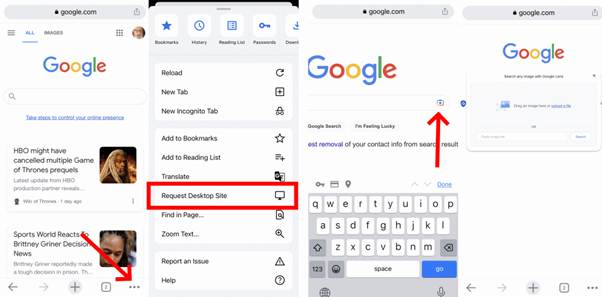
Fig 2. Pictures demonstrating reverse image search from a mobile device[46]
(b) Be aware of dedicated support networks
Second, it is crucial for seniors to be aware of dedicated support networks to seek assistance with digital issues and report scams without fear. This is crucial as deepfakes linked to financial scams tend to target seniors’ vulnerabilities. The SG Cyber Safe Seniors Programme was launched to raise awareness of cybersecurity among the elderly.[47] The programme provides a mix of physical and online platforms, including tutorial sessions on how to use mobile applications safely.[48]Family members should encourage the elderly to attend such sessions to stay informed of recent developments.
(c) Practise safe usage on social media platforms
Lastly, we should practise safe usage on social media platforms. For instance, we can change our privacy settings to limit the audience that can view our posts and be wary of unfamiliar follower requests.[49] When we find deepfake videos online, we should report them to the host social media platform.[50]
Conclusion
Recent developments in deepfake legislation are a significant step forward, but we must recognise that the law often moves far slower than the rapid development of AI technologies. Given the speed at which deepfake content can proliferate, the law serves as a vital safety net rather than a complete cure. To this end, the most effective measure is prevention through heightened public awareness.
Nevertheless, in the unfortunate circumstance that some fall victim to deepfake-related offences, prompt reporting to the police and early legal advice are essential. Victims can seek assistance through free legal clinics.[51]
Ultimately, in the war against deepfake abuse, relying solely on legislation is far from sufficient. The strongest bulwark is still a society equipped with the skills to resist deepfake deception. We must always stay vigilant.
Written by: Sarah Chan Wai Kei
Year 3 LL.B. Student
Singapore Management University, Yong Pung How School of Law
Edited by: Low En Tong
Year 2 LL.B. Student
Singapore Management University, Yong Pung How School of Law
Citations List
[1] Singapore Parliamentary Debates, Official Report (13 September 2021) vol 95 (Desmond Choo, Member of Parliament for Tampines).
[2] “Introduction to Deepfake Technology” [Digital For Life] (1 April 2025) <https://www.digitalforlife.gov.sg/learn/resources/all-resources/what-are-deepfakes> (accessed 12 June 2026).
[3] Protection from Harassment Act 2014 (2020 Rev Ed) (“Protection from Harassment Act”).
[4] “CSA’s 2024 Cybersecurity Public Awareness Survey Shows an Improvement in the Adoption of Cyber Hygiene Practices” [Cyber Security Agency of Singapore] (2 July 2025) <https://www.csa.gov.sg/news-events/press-releases/csa-s-2024-cybersecurity-public-awareness-survey-shows-an-improvement-in-the-adoption-of-cyber-hygiene-practices/> (accessed 12 June 2026).
[5] Carmen Sin, “More than 70 people threatened with fake obscene photos in mail: Police” [The Straits Times] (20 April 2024) <https://www.straitstimes.com/singapore/more-than-70-people-threatened-with-fake-obscene-photos-in-mail-police> (accessed 12 June 2026).
[6] Protection from Harassment Act 2014 (2020 Rev Ed).
[7] Id, s 12.
[8] Id, s 12(2B)(b).
[9] SG Courts, “How to file and serve a protection from harassment application” <https://www.judiciary.gov.sg/civil/how-to-file-serve-protection-from-harassment#simplified> (accessed 12 June 2026).
[10] Ibid.
[11] Ibid.
[12] SG Courts, “Before making an application for protection from harassment: understand the remedies, and the appropriate court to make your application” <https://www.judiciary.gov.sg/civil/before-making-an-application-protection-from-harassment#simplified-or-standard> (accessed 12 June 2026).
[13] Ibid.
[14] Ministry of Law, “Protection Orders” <https://www.mlaw.gov.sg/files/3msd061_minlaw_infographic_annex_091215.pdf> (accessed 12 June 2026).
[15] Ibid.
[16] Ibid.
[17] Ibid.
[18] Ibid.
[19] Ibid.
[20] Ibid.
[21] Syarafana Shafeeq, “Anonymous perpetrators a major roadblock for victims of online harm seeking justice: Study” [The Straits Times] (29 May 2025) <https://www.straitstimes.com/singapore/anonymity-a-major-roadblock-for-victims-of-online-harm-to-take-action-and-seek-justice-she-study> (accessed 12 June 2026).
[22] Online Safety (Relief and Accountability) Act 2025 (No. 23 of 2025) (“Online Safety (Relief and Accountability) Act”).
[23] Penal Code 1871 (2020 Rev Ed) (“Penal Code”).
[24] Ministry of Law, “Online Safety Commission and Online Safety (Relief and Accountability) Act 2025 to Start on 29 June 2026” (14 May 2026) <https://www.mlaw.gov.sg/online-safety-commission-and-online-safety-relief-and-accountability-act-2025-to-start-on-29-june-2026/> (accessed 12 June 2026).
[25] Ibid.
[26] Ibid.
[27] Lee Li Ying, “Singapore Parliament passes online harms Bill after more than eight hours of debate” [The Straits Times] (5 November 2025). <https://www.straitstimes.com/singapore/politics/singapore-parliament-passes-online-harms-bill-after-more-than-eight-hours-of-debate> (accessed 12 June 2026).
[28] Online Safety (Relief and Accountability) Act, s 43 and s 46.
[29] Id, s 52, s 53 and s 55.
[30] Criminal Law (Miscellaneous Amendments) Act 2025 (No. 21 of 2025) (“Criminal Law (Miscellaneous Amendments) Act”).
[31] Ministry of Home Affairs, “Commencement of the Criminal Law (Miscellaneous Amendments) Act 2025” (19 December 2025) <https://www.mha.gov.sg/media-room/newsroom/commencement-of-the-criminal-law-miscellaneous-amendments-act-2025/> (accessed 12 June 2026).
[32] Penal Code, s 377BE(5).
[33] Criminal Law (Miscellaneous Amendments) Act, s 50(a) and s 50(b).
[34] Id, s 50(c).
[35] “Advisory on Detecting and Responding to Deepfake Scams” [Cyber Security Agency of Singapore] (22 March 2024) <https://www.csa.gov.sg/alerts-and-advisories/advisories/ad-2024-006/> (accessed 12 June 2026).
[36] Ibid.
[37] Ibid.
[38] Ibid.
[39] Ibid.
[40] Ibid.
[41] Chan Eu Imm, “CNA Explains: How to spot the telltale signs of a deepfake” [Channel News Asia] (14 September 2024) <https://www.channelnewsasia.com/singapore/deepfakes-cna-explains-ai-how-4603136> (accessed 12 June 2026).
[42] Ibid.
[43] Ibid.
[44] Ibid.
[45] Ibid.
[46] Eric Griffith, “How to Do a Reverse Image Search From Your Phone” [PCMag] <https://www.pcmag.com/how-to/how-to-do-a-reverse-image-search-from-your-phone> (accessed 12 June 2026).
[47] Cyber Security Agency of Singapore, “SG Cyber Safe Seniors Programme” <https://www.csa.gov.sg/our-programmes/cybersecurity-outreach/sg-cyber-safe-seniors/> (accessed 12 June 2026).
[48] Singapore Parliamentary Debates, Official Report (2 April 2024) vol 95 (K Shanmugam Minister for Law and Minister for Home Affairs).
[49] Dillon Loh, “What can you do if you are the target of deepfake nudes?” [The Straits Times] (4 December 2024.) <https://www.straitstimes.com/singapore/what-can-you-do-if-you-are-the-target-of-deepfake-nudes> (accessed 12 June 2026).
[50] Ibid.
[51] Pro Bono SG, “List of Legal Clinics in Singapore” <https://www.probono.sg/get-legal-help/legal-guidance/the-general-public/legal-clinics-in-singapore/> (accessed 12 June 2026).
-
Understanding the Rationale and Impact of the Sentencing Advisory Panel (SAP) Sentencing Guidelines for Scam-Related Offences
 SMU Constitutional Law and Criminal Justice Club