
You open WhatsApp to find another “frequently forwarded” text in your group chat: “Man hospitalised after eating durians. Don’t eat durians.” In a world more connected than ever, we interact with others and consume information through various sources: small talks with coworkers, conversations with friends, news from the media, and more.
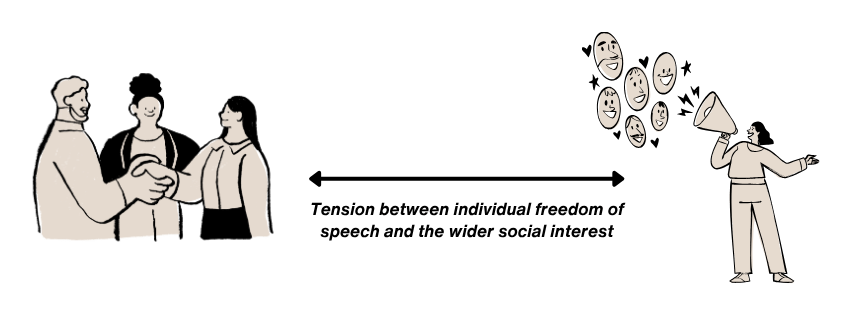
Indeed, freedom of speech and expression allows us to share information freely. But what happens when everyone exercises that freedom without a second thought? Should society stop eating durians just because someone claimed they were “dangerous”? Words have consequences — for those speaking and those on the receiving end. The tension between individual freedom of speech and restricting it for wider societal interest has always been challenging to navigate. In this article, we’ll explore how freedom of speech is protected under Singapore’s Constitution, and when restrictions of this freedom are considered lawful.
Article 14 of the Constitution
Article 14 is found in the section of the Constitution that deals with fundamental liberties. It protects three related rights:
(a) Freedom of speech and expression — communicating and sharing information;
(b) Freedom of assembly — gathering in groups peacefully; and
(c) Freedom of association — the ability to form or join groups or organisations.1
In this article, we will focus on freedom of speech and expression.
Why does freedom of speech matter?
Every Singapore citizen has the right to freedom of speech and expression.2 With this right, we can talk freely with one another about the things that matter to us, subject to the limitations mentioned later in this article. But why exactly is this right so important?
Reason 1: Marketplace of ideas
Through open discussions, we explore new ideas that we may not have considered before. Hearing opinions that agree or disagree with our own helps us rethink our views — “Eh, maybe you’re right” or “No leh, actually …” Gradually, this back-and-forth helps society discover the truth.3

Reason 2: Supporting Singapore’s development
Policy issues, such as the Singapore Budget and Housing Development Board (HDB) projects, directly affect us. By talking about them, citizens participate in public discourse and more voices are heard. Diverse perspectives help to improve policies, keep governments accountable, and strengthen democracies.4 Think of it like giving feedback in a survey — sharing your thoughts could make a difference.
Limits to Article 14
But can we really say anything we want? The short answer is no. Like most constitutional rights in Singapore and elsewhere, the freedom of speech is not absolute. It can be restricted by law and does not apply to certain types of expression, as we explain below.5
Restrictions by law
Parliament may introduce restrictions considered necessary or expedient in the interest of Singapore’s security, friendly relations with other countries, public order, or morality.6 In other words, these are the only reasons that Parliament may rely upon to lawfully restrict the freedom of speech.
The purposes of restrictions by law are to:
(a) Protect Parliament’s privileges; or
(b) Provide against:
(i) Contempt of court;
(ii) Defamation; or
(iii) Incitement to any offence.7
We will explore contempt of court, defamation, and incitement to any offence in greater detail.
Contempt of court
Contempt of court occurs when someone disrespects the courts, disobeys court orders, or interferes with ongoing cases.8 For a recent example, Pritam Singh, then Leader of the Workers Party, remarked that “the court of public opinion can be bigger than any court in the world,” implying that public opinion could outweigh a court’s judgement. This statement could potentially constitute contempt of court, and he has since apologised for it.9
Defamation
Defamatory statements are those that harm a person’s reputation, and there are laws in place to protect those on the receiving end of such statements.10 In Singapore, these laws include the Defamation Act and Section 499 of the Penal Code (criminal defamation). We often hear of defamation lawsuits involving public figures, but anyone could defame someone or be a victim themselves.
Just last year in Singapore, the court ordered Ms Wu, a housewife, to pay S$25,000 to D’Season for a defamatory post about beansprouts.11 Yes, beansprouts. In 2022, Ms Wu took to Facebook to express her dissatisfaction with beansprouts sold by D’Season. Among other statements, she remarked that the beansprouts were “basically poisonous vegetables.” This suggested D’Season either was dishonest, since they allegedly sold organic products, or sold unsafe products. D’Season sued Ms Wu for defamation, and in 2025, the court held that her statements were indeed defamatory. Defamation cases show how the law can operate to restrict freedom of speech when statements go too far and cause harm.
Incitement to offences
Incitement in this regard refers to encouraging another person to commit an offence — for instance, stealing. Freedom of speech and expression does not protect such incitement, for obvious reasons. In more severe cases, incitement may even amount to an abetment offence, which is punishable under criminal law.12 Simply put: you should never encourage anyone to break the law.
Expressions not protected by Article 14
Apart from contempt of court, defamation, and incitement to offences, false speech and non-written/spoken expression are not covered by Article 14 and hence do not enjoy protection under this constitutional provision.
False speech
Article 14 protects the right to make truthful statements, unless these amount to contempt of court, defamation, or the incitement of offences. Accordingly, this excludes false speech.13 This restriction is crucial since false speech can cause dire consequences, such as undermining the quality of public discourse and creating public anxiety.
Remember the panic many people felt hearing news during the Covid-19 pandemic? During this pandemic, there were waves of misinformation that fuelled fear of contracting the virus, both locally and globally.14 In Singapore, the Protection from Online Falsehoods and Manipulation Act (POFMA) was relied on in response, with over a quarter of the POFMA orders issued in 2020 being related to the pandemic.15 As its name suggests, POFMA combats false online statements.16 The most common tool sought under POFMA is correction directions; they require the author to publish correction statements alongside their initial false statements.17
Non-written/spoken expression
Article 14 only protects written and spoken communication.18 Otherwise, almost anything could be interpreted as “expression”.19 For this reason, non-written/spoken expressions such as gestures, are not protected by Article 14. For instance, in 2022, climate protesters threw tomato soup over Vincent van Gogh’s Sunflowers paintings at the National Gallery in London.20 If this had happened in Singapore, the perpetrators would not have been able to rely on the protection offered by Article 14, since such an act was neither written nor spoken expression.
Takeaways
Freedom of speech is a constitutional right available to all Singapore citizens. Understanding your right as protected by Article 14 also allows you to understand when restrictions are lawful and when they are not. The next time you encounter a debate between freedom of speech and public interest, ask yourself: is the restriction of freedom of speech legally justified under the Constitution?
Written by: Sherwin and Megan
Year 3 LL.B. Students
Singapore Management University, Yong Pung How School of Law
Edited by: Jemimah
Year 4 LL.B. Student
Singapore Management University, Yong Pung How School of Law
Citations list
Constitution of the Republic of Singapore. Article 14(1).
Review Publishing Co Ltd and Another v Lee Hsien Loong and Another Appeal [2009] SGCA 46 at [280] <https://www.elitigation.sg/gd/s/2009_SGCA_46>.
Ministry of Law. (May 7, 2019). Second Reading Speech by Minister for Law, K Shanmugam on The Protection from Online Falsehoods and Manipulation Bill. Para 102. <https://www.mlaw.gov.sg/news/parliamentary-speeches/second-reading-speech-by-minister-for-law-k-shanmugam-on-the-protection-from-online-falsehoods-and-manipulation-bill/>.
Constitution of the Republic of Singapore. Article 14(2) and 14(3).
Singapore Legal Advice. (January 22, 2024). What is the Offence of Contempt of Court in Singapore? <https://singaporelegaladvice.com/law-articles/contempt-of-court-singapore/>.
Ng W. K. (December 14, 2025). Pritam Singh, Mediacorp Apologise After Comments on CNA Show Which AGC Said Are in Contempt of Court. <https://www.singaporelawwatch.sg/Headlines/pritam-singh-mediacorp-apologise-after-comments-on-cna-show-which-agc-said-are-in-contempt-of-court>.
Defamation Act 1957.
Penal Code 1871. Section 499.
Lim, W. (May 14, 2025). Defamation Law in Singapore. <https://www.wmhlaw.com.sg/articles/2025/05/14/defamation-law-in-singapore>.
Lam, L. (September 10, 2025). Housewife Ordered to Pay S$25,000 to Company Over Defamatory Facebook Post on Its Beansprouts, Kale.<https://www.channelnewsasia.com/singapore/housewife-25k-damages-defame-taiwan-produce-reseller-5341611>.
Penal Code 1871. Chapter 5.
Attorney-General v Ting Choon Meng and another appeal [2017] SGCA 6 at [117] <https://www.elitigation.sg/gd/s/2017_SGCA_6>.
Soon, C. (August 31, 2022). Fighting an Information Avalanche During Covid-19 Outbreak. <https://www.todayonline.com/commentary/fighting-information-avalanche-covid-19-outbreak-fake-news-WhatsApp>.
Protection from Online Falsehoods and Manipulation Act 2019.
Goh, Y. H. (August 1, 2024). Five Years of Pofma: How Has the Law Been Used to Combat Fake News? <https://www.straitstimes.com/singapore/five-years-of-pofma-how-has-the-law-been-used-to-combat-fake-news>.
Oon & Bazul. (May 7, 2025). POFMA in Singapore – Balancing Free Speech and Truth in the Digital Age. <https://oonbazul.com/pofma-in-singapore-balancing-free-speech-and-truth-in-the-digital-age/>.
POFMA Office. (November 17, 2025). Protection from Online Falsehoods and Manipulation. <https://www.pofmaoffice.gov.sg/regulations/protection-from-online-falsehoods-and-manipulation-act/>.
Tan Seng Kee v Attorney-General [2022] SGCA 14 at [284] <https://www.elitigation.sg/gd/s/2022_sgca_16>.
Wolfe, J. (March 28, 2025). Climate Activists Who Threw Soup at van Gogh Painting Are Changing Tactics. <https://www.nytimes.com/2025/03/28/world/europe/climate-activists-museum-protests.html#:~:text=Just%20Stop%20Oil%20activists%20made,Diego%20Vel%C3%A1zquez’s%20%E2%80%9CRokeby%20Venus.%E2%80%9D>.
-
Understanding the Rationale and Impact of the Sentencing Advisory Panel (SAP) Sentencing Guidelines for Scam-Related Offences
- Constitution of the Republic of Singapore. Article 14(1). ↩︎
- Constitution of the Republic of Singapore. Article 14(1). ↩︎
- Review Publishing Co Ltd and Another v Lee Hsien Loong and Another Appeal [2009] SGCA 46 at [280] https://www.elitigation.sg/gd/s/2009_SGCA_46. ↩︎
- Ministry of Law. (May 7, 2019). Second Reading Speech by Minister for Law, K Shanmugam on The Protection from Online Falsehoods and Manipulation Bill. Para 102.
https://www.mlaw.gov.sg/news/parliamentary-speeches/second-reading-speech-by-minister-for-law-k-shanmugam-on-the-protection-from-online-falsehoods-and-manipulation-bill/. ↩︎ - Constitution of the Republic of Singapore. Article 14(2) and 14(3). ↩︎
- Constitution of the Republic of Singapore. Article 14(2). ↩︎
- Constitution of the Republic of Singapore. Article 14(2). ↩︎
- Singapore Legal Advice. (January 22, 2024). What is the Offence of Contempt of Court in Singapore? https://singaporelegaladvice.com/law-articles/contempt-of-court-singapore/. ↩︎
- Ng W. K. (December 14, 2025). Pritam Singh, Mediacorp Apologise After Comments on CNA Show Which AGC Said Are in Contempt of Court.
https://www.singaporelawwatch.sg/Headlines/pritam-singh-mediacorp-apologise-after-comments-on-cna-show-which-agc-said-are-in-contempt-of-court. ↩︎ - Lim, W. (May 14, 2025). Defamation Law in Singapore. https://www.wmhlaw.com.sg/articles/2025/05/14/defamation-law-in-singapore. ↩︎
- Lam, L. (September 10, 2025). Housewife Ordered to Pay S$25,000 to Company Over Defamatory Facebook Post on Its Beansprouts, Kale. <https://www.channelnewsasia.com/singapore/housewife-25k-damages-defame-taiwan-produce-reseller-5341611>. ↩︎
- Penal Code 1871. Chapter 5. ↩︎
- Attorney-General v Ting Choon Meng and another appeal [2017] SGCA 6 at [117] <https://www.elitigation.sg/gd/s/2017_SGCA_6>. ↩︎
- Soon, C. (August 31, 2022). Fighting an Information Avalanche During Covid-19 Outbreak. <https://www.todayonline.com/commentary/fighting-information-avalanche-covid-19-outbreak-fake-news-WhatsApp>. ↩︎
- Goh, Y. H. (August 1, 2024). Five Years of Pofma: How Has the Law Been Used to Combat Fake News? <https://www.straitstimes.com/singapore/five-years-of-pofma-how-has-the-law-been-used-to-combat-fake-news>. ↩︎
- Oon & Bazul. (May 7, 2025). POFMA in Singapore – Balancing Free Speech and Truth in the Digital Age. <https://oonbazul.com/pofma-in-singapore-balancing-free-speech-and-truth-in-the-digital-age/>. ↩︎
- POFMA Office. (November 17, 2025). Protection from Online Falsehoods and Manipulation. <https://www.pofmaoffice.gov.sg/regulations/protection-from-online-falsehoods-and-manipulation-act/>. ↩︎
- Tan Seng Kee v Attorney-General [2022] SGCA 14 at [284] <https://www.elitigation.sg/gd/s/2022_sgca_16>. ↩︎
- Tan Seng Kee v Attorney-General [2022] SGCA 14 at [285] <https://www.elitigation.sg/gd/s/2022_sgca_16>. ↩︎
- Wolfe, J. (March 28, 2025). Climate Activists Who Threw Soup at van Gogh Painting Are Changing Tactics. <https://www.nytimes.com/2025/03/28/world/europe/climate-activists-museum-protests.html#:~:text=Just%20Stop%20Oil%20activists%20made,Diego%20Vel%C3%A1zquez’s%20%E2%80%9CRokeby%20Venus.%E2%80%9D>. ↩︎

